Biblical Tour  ·  Our Longest Itinerary

Footsteps of St. Paul Tour in Turkey: Antioch to Istanbul (15 Days)

Our most complete Biblical journey, tracing the Apostle Paul's missionary routes from Antioch and Tarsus through Iconium, Pisidian Antioch, Perge and Myra, on to Colossae, Laodicea, Pamukkale, all Seven Churches of Revelation, Troy, Nicea and Istanbul.

14 Nights, Breakfast Included Most Dinners Included Licensed Biblical Guides 15+ Cities, One Journey $3,129 per person
15
Days / 14 Nights
15+
Biblical & Historic Cities
All 7
Churches of Revelation
$3,129
Per Person

A Complete Journey Through Paul's Missionary Turkey

Ruins of Antioch in Pisidia
Antioch in Pisidia, where Paul preached in the synagogue
Pamukkale travertine terraces
Pamukkale and Hierapolis, beside Laodicea and Colossae
Library of Celsus at Ephesus
Ephesus, where Paul taught for nearly three years
Antalya coast and old harbour
Antalya, the ancient port of Attalia
Bosphorus cruise at sunset
The Bosphorus, Istanbul
Istanbul skyline with domes and minarets
Istanbul: Hagia Sophia and the Old City

This 15-day Footsteps of St. Paul tour in Turkey is our longest and most complete Biblical tour, a Christian pilgrimage and cultural journey that traces the Apostle Paul's missionary journeys across Anatolia. It begins in Antioch (Antakya), where believers were first called Christians and from where Paul and Barnabas were sent out, and ends in Istanbul. Along the way you stand in the places named in the Book of Acts and in Paul's letters, guided by licensed English-speaking guides with real Biblical and historical knowledge.

Following Paul's Missionary Journeys

The route follows the apostle's story in the order the landscape allows. In Tarsus you visit Paul's birthplace and the so-called Well of St. Paul. The sites of the First Missionary Journey (Acts 13–14) include Perge, Antioch in Pisidia and Iconium (Konya). Further west you reach the Aegean world of the Second and Third Missionary Journeys: Alexandria Troas, where Paul saw the vision of the man of Macedonia, Assos, and Ephesus, where he taught for nearly three years. At Myra, the port where Paul changed ships on his voyage to Rome, the Acts narrative on the south coast comes full circle.

All Seven Churches of Revelation

The itinerary also completes the Seven Churches of Revelation: Ephesus, Smyrna (Izmir), Pergamon, Thyatira, Sardis, Philadelphia and Laodicea. Near Laodicea you also see Colossae and Hierapolis at Pamukkale, the region addressed in Paul's letter to the Colossians. If you are searching for a Seven Churches tour that goes further, into the full world of the New Testament, this route covers both in a single trip.

History, Culture and Landscape

Alongside the Biblical narrative, the route takes in extraordinary historical wonders: the Temple of Artemis and the Library of Celsus at Ephesus, the theatres of Perge and Pergamon, the white travertine terraces of Pamukkale, the legendary ruins of Troy, Iznik (Nicea), site of the first ecumenical council in AD 325, and Istanbul's Hagia Sophia, Topkapi Palace, Blue Mosque and Bosphorus. Konya adds the Mevlana Museum and the early Christian village of Sille. It is a tour that blends faith, archaeology and Turkish culture into one unhurried connection to the roots of Christianity.

Small-Group or Private Tour

The tour can run as a small-group departure or be arranged as a private Turkey tour for your church group, family or friends, with 14 nights in 3, 4 or 5-star hotels, boutique hotels or cave hotels, breakfast daily, dinner on most nights, air-conditioned transport, entrance fees and airport transfers included. It suits Christian pilgrims, Bible-study groups, history lovers and active older travellers. As an Istanbul-based operator with a 5.0 rating on TripAdvisor, The History Travel Agency organises every stage personally, from the airport welcome to the final transfer. Send an enquiry or WhatsApp us for dates, a private quote and the current status of the Hatay sites.

Hatay update: Antakya and other parts of Hatay were badly affected by the February 2023 earthquakes, and restoration of museums and churches is ongoing. We confirm which Day 1–2 sites are open before departure, and your guide adapts the programme where needed. Ask us for the current status when you enquire.

Why this route works

The itinerary follows the logic of Acts: Syria and Cilicia first, then the Anatolian plateau, the Pamphylian coast and the Aegean, and finally the Marmara region where early Christianity became an imperial faith. Each stage changes the landscape, the food and the pace, so no day feels repeated.

Hotels change every one or two nights, which keeps you positioned for the next day's sites without long late-night transfers. Pack light and expect a fair amount of driving between historic places.

Tour at a glance

  • 15 days, 14 nights
  • Antakya to Istanbul, across 15+ cities
  • All Seven Churches of Revelation
  • Small-group or private departure
  • Licensed English-speaking guides
  • Breakfast daily, dinner on most nights
  • Entrance fees and taxes included
  • New air-conditioned vehicles
Duration
15 Days
14 nights
Starts
Antakya
Hatay Airport
Ends
Istanbul
airport transfer
Price
$3,129
per person
Your route

The Journey at a Glance

Eight stages, from the Syrian border region to the Bosphorus. The number in each circle is the day on which that stage begins.

1
Antakya
2
Adana & Tarsus
3
Konya
4
Pisidia, Perge, Antalya & Myra
6
Colossae & Pamukkale
7
Seven Churches & Ephesus
11
Troas, Troy & Nicea
13
Istanbul

Paul in the Texts: What You Will Be Reading Beside

Not every stop is a Pauline foundation, and we say so on site. This is how the places on the route connect to the New Testament.

First Journey

Paul and Barnabas sail from Seleucia Pieria, then preach at Perge, Antioch in Pisidia and Iconium before returning via Attalia (Antalya). Acts 13–14.

Second Journey

Paul travels through his home region of Cilicia and the Anatolian plateau to Alexandria Troas, where the vision of the man of Macedonia sends him to Europe. Acts 15–16.

Third Journey

Paul spends nearly three years at Ephesus, then passes through Troas and Assos on his way back toward Jerusalem. Acts 19–20.

The Voyage to Rome

Years later Paul, now a prisoner, changes ships at Myra on the Lycian coast, the start of the voyage and shipwreck of Acts 27.

The Letters

Colossians was written to a church Paul did not found himself and mentions neighbouring Laodicea. Both lie within sight of Pamukkale. Colossians 1:7, 4:12–16.

The Seven Churches

The letters in Revelation 2–3 come from John, not Paul. Ephesus is the one city on the list closely tied to Paul, and the others show how the faith grew after him.

Your Detailed 15-Day Itinerary

Fifteen days, city by city

Tap any day to read what you will see, where Paul fits in and which meals are included. Timings are approximate and may be adjusted for traffic, weather and opening hours. Mosques, including Hagia Sophia and Chora, follow prayer times and current visiting arrangements.

1

Arrive Antakya & Antioch Tour

Meals: Dinner  ·  Overnight: Hatay

Welcome to Turkey! Upon landing at Hatay Airport, your guide greets you and begins the journey in Antakya, ancient Antioch on the Orontes, in its day the third-largest city of the Roman Empire after Rome and Alexandria. According to the Book of Acts, it was here that Jesus's followers were first called "Christians" (Acts 11:26), here that Barnabas and Paul taught side by side for a year, and here that the church sent them out on the first missionary journey (Acts 13:1-3).

Our first visit is to the Hatay Archaeological Museum, home to one of the world's great collections of Roman mosaics, rescued from villas and bathhouses across ancient Antioch. We then visit the Church of Saint Pierre (St. Peter), a cave church carved into the slope of Mount Staurin and traditionally regarded as one of the earliest places of Christian worship, where early believers gathered during periods of persecution. Overnight in Hatay, with dinner included.

Acts 11:26 · 13:1-3 Airport transfer
2

Hatay, Adana & Tarsus

Meals: Breakfast, Dinner  ·  Overnight: Adana

After breakfast we drive toward the coast to Seleucia Pieria, once the seaport of ancient Antioch and the harbour from which Paul and Barnabas set sail at the start of their first missionary journey (Acts 13:4). Nearby is the Titus Tunnel, a Roman engineering feat carved through solid rock to divert floodwaters from the harbour, begun under Vespasian and completed under his son Titus. We also see Besikci Cave along the same stretch of coast.

Continuing inland, we reach Adana, Turkey's fourth-largest city and an important crossroads of trade since antiquity, for a guided tour of its riverside promenade on the Seyhan. We then press on to Tarsus, the birthplace of Saul, the future Apostle Paul, who called it "no mean city" (Acts 21:39). We visit the Well of St. Paul, traditionally associated with his family home, and the Gate of Cleopatra, a Roman-era gateway linked to the meeting of Cleopatra and Mark Antony in 41 BC. Overnight in Adana, with dinner included.

Acts 13:4 · 21:39
3

Adana, Konya & Sille Village

Meals: Breakfast, Dinner  ·  Overnight: Konya

After breakfast we begin the drive of about five hours to Konya, known in antiquity as Iconium. Paul and Barnabas preached here on their first missionary journey (Acts 14:1-3), speaking boldly in the synagogue and drawing both believers and fierce opposition.

Our first stop is the Mevlana Museum, the turquoise-domed shrine of the 13th-century poet and mystic Jalal ad-Din Rumi, founder of the Mevlevi order of Whirling Dervishes. Next is the Karatay Museum, a Seljuk madrasah built in 1251 and now home to a superb collection of Seljuk tile art beneath a star-patterned dome.

After lunch at a local restaurant we visit Sille Village, a settlement with a history stretching back some 4,500 years and a long-standing Christian community. By local tradition, St. Paul himself found refuge here. Among its treasures is the Ak Monastery (Hagios Khariton), a cave-and-stone monastery that offers a tangible glimpse of the region's layered spiritual past. Overnight in Konya, with dinner included.

Acts 14:1-3
4

Antioch in Pisidia & Perge

Meals: Breakfast, Dinner  ·  Overnight: Antalya
Ruins of Antioch in Pisidia Antioch in Pisidia, where Paul preached (Acts 13)

This morning we drive to the ruins of Antioch in Pisidia, near the modern town of Yalvac. In the city's synagogue Paul delivered one of his longest recorded sermons (Acts 13:16-41), tracing Israel's history from Egypt to David and proclaiming Jesus as the promised Messiah. The message won many converts and stirred such opposition that the missionaries were driven out of the region (Acts 13:50). We walk among the colonnaded streets, the remains of the Temple of Augustus and the Sanctuary of Men, and the ruins of a Byzantine basilica traditionally associated with the site of Paul's preaching. We also visit the small Yalvac Archaeological Museum.

We then continue south to Antalya, ancient Attalia, from where Paul and Barnabas sailed back to Antioch to report on their journey (Acts 14:24-26). En route we stop at Perge, which they visited twice (Acts 13:13-14, 14:25). Perge reveals one of the best-preserved ancient theatres in Anatolia, a monumental Hellenistic gate flanked by round towers, a colonnaded main street with its central water channel, and the remains of Roman baths. Overnight in Antalya, with dinner included.

Acts 13:13-52 · 14:24-26
5

Demre, St. Nicholas Church & Myra

Meals: Breakfast, Dinner  ·  Overnight: Antalya
Antalya old harbour and coast Antalya's old harbour, ancient Attalia

We begin with a walk through Antalya's preserved Old Town (Kaleici), a maze of cobbled lanes, Ottoman wooden houses and courtyards behind ancient walls. Highlights include Hadrian's Gate, a triple-arched marble gateway built in 130 AD to honour the emperor's visit, the historic Clock Tower and the 13th-century Fluted (Yivli) Minaret, still the symbol of the city's skyline.

From Antalya we drive west along a spectacular stretch of Mediterranean coast to Demre, ancient Myra, to visit the Church of St. Nicholas. This Byzantine church honours the 4th-century bishop of Myra, remembered for quiet generosity to the poor, whose story over many centuries and cultures grew into the legend of Santa Claus. We continue into Myra, where Lycian rock-cut tombs are carved into a cliff face like temple facades, with a well-preserved Roman theatre at its base. This was also the port where, years after his missionary journeys, Paul was placed aboard an Alexandrian grain ship as a prisoner bound for Rome (Acts 27:5-6), the start of the voyage and shipwreck that close the Book of Acts. Overnight in Antalya, with dinner included.

Acts 27:5-6
6

Colossae, Laodicea, Pamukkale & Hierapolis

Meals: Breakfast, Dinner  ·  Overnight: Pamukkale
Pamukkale travertine terraces Pamukkale, beside Hierapolis and Laodicea

Today's drive of roughly 240 km north to Pamukkale begins at Colossae, near the modern town of Honaz. The site is still a largely unexcavated mound, but its significance is immense: this was the church to which Paul addressed his Epistle to the Colossians, written from prison, a congregation that Epaphras, a native of Colossae, had likely founded (Colossians 1:7, 4:12-13). We continue to Laodicea, one of the Seven Churches of Revelation and perhaps the most memorably rebuked: "because you are lukewarm, and neither cold nor hot, I will spit you out of my mouth" (Rev 3:14-22). Among its excavated stadium, church and the remnants of the city's distinctive water pipes, it is easy to picture the wealthy, self-satisfied city John addressed.

Arriving in Pamukkale, we explore the UNESCO World Heritage city of Hierapolis, built around thermal springs prized since antiquity. Highlights include the Martyrium of the Apostle Philip, an octagonal structure commemorating the site of his martyrdom, the monumental Gate of Domitian and a beautifully preserved Roman theatre. We close the day with a barefoot walk across Pamukkale's white travertine terraces, layered pools of mineral-rich water that give the site its Turkish name, "Cotton Castle." Overnight at a thermal hotel in Pamukkale, with dinner included.

Col 1:7 · 4:12-16 · Rev 3:14-22
7

Philadelphia, Sardis & Smyrna

Meals: Breakfast, Dinner  ·  Overnight: Izmir

We begin in Philadelphia, modern Alasehir. Together with Smyrna, it is one of only two of the Seven Churches of Revelation to receive no word of rebuke; it was praised for its patient endurance and promised an open door that no one could shut (Rev 3:7-13). The atmospheric ruins of a Byzantine basilica still stand, its brick pillars surrounded by later buildings. We continue to Sardis, once the glittering capital of the Lydian kingdom under King Croesus, whose wealth gave us the phrase "rich as Croesus." By the time John wrote to its church, Sardis had grown spiritually complacent, prompting the warning to "wake up, and strengthen what remains" (Rev 3:1-6). Here we explore the restored Roman Gymnasium and Bath complex and the towering columns of the Temple of Artemis, one of the largest Ionic temples ever built.

Continuing to Izmir, we explore ancient Smyrna, the church singled out for its faithfulness under persecution and poverty: "be faithful unto death" (Rev 2:8-11). We visit the site associated with Saint Polycarp, a disciple of the Apostle John and Smyrna's bishop, martyred here in the 2nd century for refusing to renounce his faith, and explore the ancient Agora, a Roman marketplace whose vaulted chambers still hint at the commerce of nearly two thousand years ago. We close the day with a stroll along Izmir's lively Kordonboyu waterfront. Overnight in Izmir, with dinner included.

Rev 3:7-13 · 3:1-6 · 2:8-11
8

Izmir Agora & Sirince Village

Meals: Breakfast, Dinner  ·  Overnight: Kusadasi

This morning we round out our exploration of Smyrna with a closer look at its Roman-era remains and the Church of St. Polycarp, which honours the city's martyred bishop. We then wander through the Kemeralti Bazaar, a sprawling covered market that has served the city's traders for centuries, its narrow lanes packed with spice merchants, jewellers, textile stalls and artisan workshops, a welcome contrast to the ruins of the past few days.

In the afternoon we drive south toward Kusadasi, taking a scenic detour through Sirince Village, a preserved former Greek Orthodox settlement among terraced vineyards in the hills above Selcuk. Its stone houses with red-tiled roofs and its tradition of fruit wine (try the pomegranate or blackberry) make it one of the most charming stops on the journey, a peaceful afternoon before the heart of the Ephesus story tomorrow. Overnight in Kusadasi, with dinner included.

Smyrna · Rev 2:8-11
9

Ephesus, House of the Virgin Mary & St. John Basilica

Meals: Breakfast, Dinner  ·  Overnight: Kusadasi
Library of Celsus at Ephesus The Library of Celsus, Ephesus

Today belongs entirely to Ephesus, a UNESCO World Heritage Site and the crown jewel of this journey. Paul spent nearly three years of his ministry here, longer than in any other city (Acts 19:8-10), reasoning daily in the hall of Tyrannus until, as Luke records, "all the residents of Asia heard the word of the Lord." Tradition also holds that the Apostle John later lived here. We walk the marble-paved Curetes Street, past the Temple of Hadrian and the two-storey Library of Celsus, and into the vast Grand Theatre, where an angry mob of silversmiths once rallied against Paul's preaching about the cult of Artemis (Acts 19:23-41).

We continue to the site of the Temple of Artemis, one of the Seven Wonders of the Ancient World, of which only a single reconstructed column now stands. From there we visit the Basilica of St. John, built by Justinian over the traditional burial site of the Apostle, and finish at the tranquil House of the Virgin Mary, in wooded hills above Ephesus, honoured by Christian and Muslim visitors alike and traditionally linked to Mary's later years (John 19:26-27). Overnight in Kusadasi, with dinner included.

Acts 19:8-10, 23-41 · John 19:26-27
10

Thyatira & Pergamon

Meals: Breakfast, Dinner  ·  Overnight: Assos or Ayvalik

We begin in Thyatira, modern Akhisar, home town of Lydia, "a seller of purple," whom Paul met and converted far away in Philippi, making her by tradition the first documented convert to Christianity in Europe (Acts 16:14-15). The letter to Thyatira's own church in Revelation is notably strong in its warning against tolerating false teaching (Rev 2:18-29).

We then continue to Pergamon (Bergama), a UNESCO World Heritage Site and once one of the great intellectual and religious capitals of the ancient world, famous for a library said to rival Alexandria's. Revelation remembers it as the place "where Satan's throne is" (Rev 2:12-17), widely read as a reference to the dominance of the imperial cult and the great Altar of Zeus on the acropolis. We explore the Temple of Trajan, the base of the Altar of Zeus (its frieze is displayed in Berlin) and the breathtakingly steep Great Theatre, seating up to 10,000 spectators. Overnight near Assos or Ayvalik, with dinner included.

Acts 16:14-15 · Rev 2:18-29 · 2:12-17
11

Assos, Alexandria Troas & Troy

Meals: Breakfast, Dinner  ·  Overnight: Bandirma

Our first stop is Assos, a dramatic hilltop city with Bronze Age roots, perched above the Aegean with views across to the Greek island of Lesbos. During his third missionary journey Paul chose to travel the overland stretch on foot while his companions sailed ahead, before rejoining them here (Acts 20:13-14). Among the ruins of the acropolis, with its Doric temple to Athena silhouetted against the sea, it is easy to see why he might have wanted that solitude.

We continue to Alexandria Troas, a once-major Roman port mentioned repeatedly in Paul's travels: here he received his vision of the "man of Macedonia" calling him to Europe (Acts 16:8-9), and here he raised the young Eutychus after a fall from a third-floor window during a very long late-night sermon (Acts 20:6-10). Near the end of his life he asks Timothy to bring a cloak left behind here (2 Timothy 4:13). We then travel to Troy, a UNESCO World Heritage Site whose nine successive layers span over 5,000 years, immortalised by Homer's Iliad and the story of the Trojan Horse. Overnight in Bandirma, with dinner included.

Acts 16:8-9 · 20:6-14 · 2 Tim 4:13
12

Bursa & Iznik (Nicea)

Meals: Breakfast, Lunch  ·  Overnight: Istanbul

We begin in Bursa, the first great capital of the Ottoman Empire, at the foot of Mount Uludag. Here we wander the Old Silk Bazaar (Koza Han), a 15th-century caravanserai where silk cocoons are still traded under vaulted arcades, and visit the Green Mosque (Yesil Cami), completed in 1424 and celebrated for its turquoise and blue tilework.

From Bursa we continue to Iznik, ancient Nicea, of immense importance to Christian history. In 325 AD Emperor Constantine convened the First Council of Nicaea here, gathering some 300 bishops to settle the debate over the nature of Christ and producing the Nicene Creed still recited in churches today. We visit the Hagia Sophia of Iznik, a Byzantine church tradition links to the Second Council of Nicaea in 787 AD, which restored the veneration of icons after the iconoclast period. Among Nicea's Roman walls and its lakeside setting, the weight of those decisions becomes tangible. We reach Istanbul in the evening, with lunch included today.

Councils of Nicaea · AD 325 & 787
13

Bosphorus Cruise, Chora Church & Patriarchate

Meals: Breakfast, Lunch  ·  Overnight: Istanbul
Bosphorus cruise at sunset The Bosphorus between Europe and Asia

We begin the morning with Istanbul's Christian heritage beyond the famous tourist core. We follow stretches of the monumental Byzantine City Walls, the triple fortifications built under Theodosius II in the 5th century that protected Constantinople for nearly a thousand years, then visit the Chora (Kariye) Church, home to some of the finest Byzantine mosaics and frescoes in the world, dating to the early 14th century. It operates as a mosque today, so visiting follows current arrangements. We continue to the Fener district to visit Saint George's Church, seat of the Ecumenical Patriarchate of Constantinople, the spiritual centre of the Eastern Orthodox world, and the neo-Gothic Bulgarian Iron Church, prefabricated in cast iron in Vienna and shipped down the Danube to Istanbul in the 1890s.

After lunch we set out on a scenic Bosphorus Cruise between Europe and Asia, gliding past the white marble Dolmabahce Palace, the elegant Ciragan Palace and the Ortakoy Mosque beneath the Bosphorus Bridge, a relaxing way to see the city from the water. Overnight in Istanbul.

Bosphorus cruise included
14

Hagia Sophia, Topkapi Palace, Blue Mosque & Grand Bazaar

Meals: Breakfast, Lunch  ·  Overnight: Istanbul
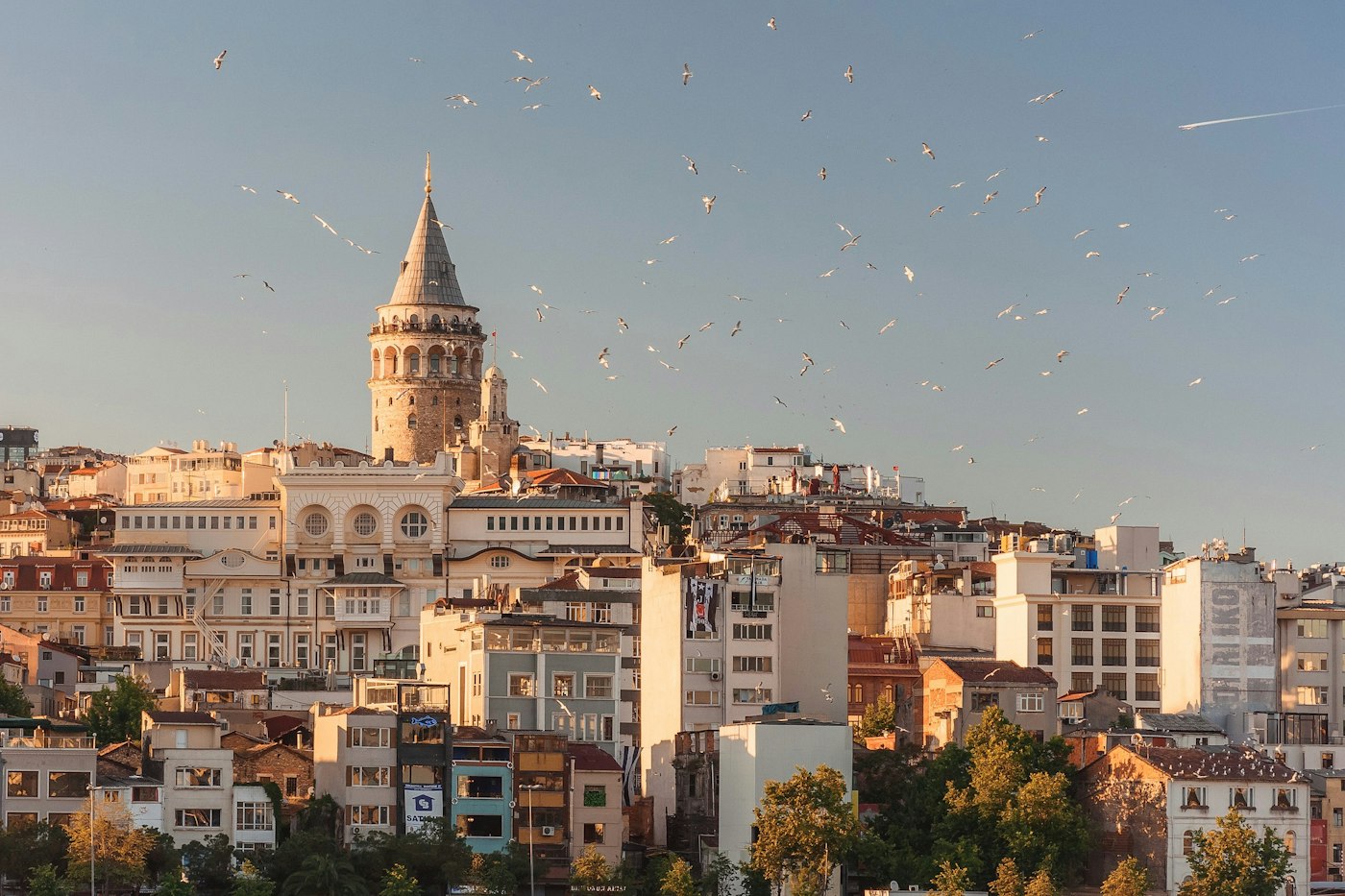
Istanbul skyline with domes and minarets Istanbul's Old City skyline

Today is devoted to the heart of Old Istanbul. We begin at Topkapi Palace, the seaside residence of Ottoman sultans for over 400 years, with its ornate courtyards, Harem quarters and treasury galleries, before continuing to Hagia Sophia, completed by Justinian in 537 AD and for nearly a thousand years the largest cathedral in the world. Its immense dome, layered mosaics and extraordinary light make it a fitting culmination for a journey through early Christian history. Hagia Sophia is a working mosque, so entry follows current visiting arrangements and prayer times, and modest dress is required.

We continue to the Blue Mosque and the Hippodrome, once the chariot-racing stadium of Byzantine Constantinople, still marked by an Egyptian obelisk and the twisted Serpent Column from Delphi, then descend into the Basilica Cistern, an underground Byzantine reservoir with 336 marble columns, including two carved with Medusa heads. The day ends with time in the labyrinthine Grand Bazaar, with over 4,000 shops selling ceramics, textiles, lamps, jewellery and carpets. Please note: the Grand Bazaar is closed on Sundays and Topkapi Palace is closed on Tuesdays; your guide will adjust the order of the day accordingly. Overnight in Istanbul, with lunch included.

Topkapi closed Tuesdays Grand Bazaar closed Sundays
15

Departure

Meals: Breakfast

After a relaxed breakfast, the day is yours in Istanbul at your own pace. Many travellers use the final morning for a last stroll through Sultanahmet, a visit to the Galata Tower for panoramic views, or a final round of shopping for Turkish delight, ceramics and textiles. When the time comes, our driver transfers you to the airport for your onward journey, carrying with you a lived understanding of the places where the early Christian story unfolded across Turkey.

Airport transfer
Destination Guides

Five Regions, Thirty Places, One Mission Story

Read ahead about what you will see: the history, the Biblical connection and the reason each stop earns its place on the route. Choose a region below to jump straight to its guide.

Antioch, Tarsus & Konya

Days 1–3 · 3 nights

Where the mission began: the first place believers were called Christians, Paul's birthplace at Tarsus, and Iconium (Konya) on the Anatolian plateau. Read what to expect at each site, including the current situation in Hatay.

Top stops

Church of St. Peter Tarsus Mevlana Museum

Read the guide

Pisidia, Pamphylia & Lycia

Days 4–5 · 2 nights

Antioch in Pisidia, where Paul preached in the synagogue, the Roman theatre of Perge and the harbour of Antalya, then Myra, where Paul changed ships on his voyage to Rome.

Top stops

Antioch in Pisidia Perge Antalya Kaleiçi Myra

Read the guide

Colossae & the Seven Churches

Days 6–10 · 5 nights

The heart of the tour: Colossae and Laodicea, Pamukkale, Philadelphia, Sardis, Smyrna, Ephesus, Thyatira and Pergamon, completing all Seven Churches of Revelation.

Top stops

Ephesus Pamukkale Pergamon Sardis

Read the guide

Troas, Troy & Nicea

Days 11–12 · 2 nights

From Assos and Alexandria Troas, where Paul saw the vision of the man of Macedonia, to the legendary ruins of Troy and Iznik, ancient Nicea, home of the first ecumenical council.

Top stops

Assos Alexandria Troas Troy Iznik (Nicea)

Read the guide

Istanbul

Days 13–14 · 2 nights

The journey ends in the former capital of Byzantium: Hagia Sophia, Topkapi Palace, the Blue Mosque, the Grand Bazaar and a Bosphorus cruise.

Top stops

Hagia Sophia Topkapi Palace Bosphorus Cruise

Read the guide

Days 1–3 · Antioch, Tarsus & Konya

Where the Mission Began

Before there were churches across Turkey, there was Antioch. It was a cosmopolitan Roman city in which a mixed congregation of Jews and Gentiles first became known as Christians, and from which Barnabas and Paul were sent out. The first three days follow that story from the Syrian border region to Paul's hometown and on to the Anatolian plateau.

Konya adds a different spiritual voice: the city of the poet Rumi and the Whirling Dervishes, set beside the early Christian village of Sille.

Hatay Archaeological Museum and the Church of St. Peter
Seleucia Pieria and the Titus Tunnel
Tarsus, the Well of St. Paul and Cleopatra's Gate
Mevlana Museum and Sille's Ak Monastery
Days 1–3
Antioch · Tarsus · Konya
Days
1–3
Nights
Hatay · Adana · Konya
Must-see
Tarsus
Best for
Bible students

Insider tip: Adana and Hatay are very hot in summer and Konya is cold in winter. Carry water, a hat and a light layer, and ask us about the current opening status of Hatay's museums and churches.

Places you will visit

Day 1

Antakya (Antioch) & Hatay Museum

Ancient Antioch was the third city of the Roman world. The Hatay Archaeological Museum displays the floor mosaics rescued from its villas and bathhouses.

Why it matters

  • The city where Jesus's followers were first called Christians.
Day 1

Church of St. Peter

A cave church cut into the slope of Mount Staurin, traditionally counted among the earliest places of Christian worship and linked to Peter's time in Antioch.

Why it matters

  • A hidden place of worship from the age of persecution.
Day 2

Seleucia Pieria & Titus Tunnel

The silted harbour of ancient Antioch, and the Roman rock-cut channel that protected it from floodwater. Standing here you can picture the ship that carried the first missionaries toward Cyprus.

Why it matters

  • The departure point of the First Missionary Journey.
Day 2

Tarsus

A prosperous centre of Hellenistic learning and the birthplace of Saul. See the Well of St. Paul, traditionally tied to his family home, and the Roman Gate of Cleopatra.

Why it matters

  • Paul's hometown, described by him as "no mean city".
Day 3

Konya (Iconium) & Mevlana Museum

Paul and Barnabas preached in Iconium's synagogue. Today the turquoise-domed Mevlana Museum holds the tomb of Rumi, and the Karatay Museum shows the best of Seljuk tile art.

Why it matters

  • Two spiritual traditions in one city.
Day 3

Sille Village & Ak Monastery

A village of about 4,500 years of history, long a refuge for Christians. The Ak Monastery (Hagios Khariton) is one of the most striking surviving monastic sites in the region.

Why it matters

  • A living link between Roman, Byzantine and Ottoman Anatolia.
Days 4–5 · Pisidia, Pamphylia & Lycia

The First Missionary Journey on Land and Sea

The route now crosses the Taurus mountains to the Mediterranean, tracing the road that Paul and Barnabas walked in Acts 13 and 14. Antioch in Pisidia gave Paul one of his best-documented sermons; Perge and Attalia were the gateway to the sea.

On the second day the road follows the Lycian coast to Myra, where the trail turns from missionary journeys to Paul's last voyage, and where the story of St. Nicholas begins.

Antioch in Pisidia, site of Paul's sermon in the synagogue
Perge's theatre, gateway and colonnaded street
Kaleici, Antalya's walled old town
St. Nicholas Church and the Lycian tombs of Myra
Ruins of Antioch in Pisidia
Days 4–5Acts 13–14 · Acts 27
Days
4–5
Nights
2 in Antalya
Must-see
Pisidian Antioch
Best for
Acts readers

Insider tip: Perge and Myra are open to the sun and the paths are uneven. Bring sun protection and sturdy shoes, and read Acts 13 on the road to Yalvac.

Places you will visit

Day 4

Antioch in Pisidia

Colonnaded streets, the Temple of Augustus, the Sanctuary of Men and a Byzantine basilica associated with the place of Paul's preaching. The Yalvac museum holds finds from the site.

Why it matters

  • Paul's long sermon here (Acts 13:16-41) is the fullest surviving example of his preaching to a synagogue.
Day 4

Perge

A wealthy Pamphylian city with a well-preserved theatre, round-towered Hellenistic gate, colonnaded street with water channel and Roman baths. Paul and Barnabas passed through twice.

Why it matters

  • Easy to read, spacious and one of the finest ancient cities on the coast.
Day 5

Kaleici, Antalya

Ancient Attalia's walled old quarter: Hadrian's Gate, the Clock Tower, the Fluted Minaret and Ottoman houses in cobbled lanes above the old harbour.

Why it matters

  • The port where Paul and Barnabas boarded ship for Syrian Antioch.
Day 5

St. Nicholas Church, Demre

The church honouring the 4th-century bishop of Myra, remembered for generosity to the poor, whose story evolved into the Santa Claus legend.

Why it matters

  • A major Byzantine pilgrimage site on the Lycian coast.
Day 5

Myra

Lycian rock-cut tombs carved into the cliff like temple facades, with a Roman theatre at its foot. Paul boarded an Alexandrian grain ship here as a prisoner (Acts 27:5-6).

Why it matters

  • The start of the voyage to Rome that ends the Book of Acts.
Days 6–10 · Colossae & the Seven Churches

The Heart of Biblical Turkey

For five days the route runs through the western province of ancient Asia: the Lycus valley of Colossae and Laodicea, the cities of Revelation and, above all, Ephesus, where Paul taught for nearly three years. It is the part of the journey that most often produces the "I have read this, and now I am standing in it" moment.

Each church has its own character: Laodicea rebuked, Philadelphia and Smyrna commended, Sardis warned, Pergamon and Thyatira tested. Your guide reads the relevant passage on site.

Colossae, Laodicea and the travertine terraces of Pamukkale
Philadelphia, Sardis and Smyrna
Ephesus, St. John Basilica and the House of the Virgin Mary
Thyatira and Pergamon's Great Theatre
Library of Celsus at Ephesus
Days 6–10Seven Churches of Revelation
Days
6–10
Nights
Pamukkale · Izmir · Kusadasi ×2 · Assos
Must-see
Ephesus
Best for
Revelation readers

Insider tip: Ephesus is largely unshaded and the marble is slippery. Visit early, wear grip-soled shoes and carry water. Pamukkale's terraces are walked barefoot.

Places you will visit

Day 6

Colossae

A grass-covered mound near Honaz, still unexcavated. Its significance is the letter Paul wrote to the church there, probably founded by Epaphras.

Why it matters

  • The recipient of the Epistle to the Colossians.
Day 6

Laodicea

A wealthy banking and textile city. Excavated stadium, church and stone water pipes help explain the image of the "lukewarm" church in Revelation 3.

Why it matters

  • One of the Seven Churches, and named in Colossians.
Day 6

Hierapolis & Pamukkale

A UNESCO World Heritage Site built around thermal springs, with the Martyrium of Philip, the Gate of Domitian and a Roman theatre beside the white travertine pools.

Why it matters

  • A Roman spa city and Christian pilgrimage site in a landscape found nowhere else.
Day 7

Philadelphia (Alasehir)

The ruins of a Byzantine basilica with towering brick pillars, standing among later buildings.

Why it matters

  • Praised for endurance and promised an open door (Rev 3:7-13).
Day 7

Sardis

Capital of Croesus's Lydian kingdom, with a restored Roman Gymnasium and Bath complex and the huge Ionic columns of the Temple of Artemis.

Why it matters

  • A famous city warned to "wake up" (Rev 3:1-6).
Days 7–8

Smyrna (Izmir)

The Roman Agora, the Church of St. Polycarp and the Kemeralti Bazaar, still the commercial heart of the city.

Why it matters

  • A church commended in suffering, and home to Bishop Polycarp.
Day 9

Ephesus

Curetes Street, the Library of Celsus and the 25,000-seat Grand Theatre, plus the site of the Temple of Artemis, the Basilica of St. John and the House of the Virgin Mary.

Why it matters

  • Paul's longest ministry (Acts 19), and the best-preserved city on the tour.
Day 10

Thyatira (Akhisar)

The home town of Lydia, "a seller of purple," whom Paul met in Philippi. Modest remains lie in the middle of a modern town.

Why it matters

  • A church warned about tolerating false teaching (Rev 2:18-29).
Day 10

Pergamon

A UNESCO World Heritage acropolis with the Temple of Trajan, the base of the Altar of Zeus and a Great Theatre seating up to 10,000 on a steep hillside.

Why it matters

  • "Where Satan's throne is" (Rev 2:12-17), a city dominated by the imperial cult.
Days 11–12 · Troas, Troy & Nicea

From the Aegean to the Councils

The northern stretch of the tour follows two threads. In the Troad, Paul's third journey meets Homer's Troy at Alexandria Troas and Assos. Further east, Nicea shows how the early church defined its faith in the creed that is still recited today.

A morning in Bursa, the first Ottoman capital, links the Byzantine world to what came next.

Assos and its Doric Temple of Athena
Alexandria Troas, the "man of Macedonia" vision
Troy, nine layers of settlement over 5,000 years
Bursa's Koza Han and Green Mosque, and Iznik (Nicea)
Days 11–12
Troas · Troy · Nicea
Days
11–12
Nights
Bandirma · Istanbul
Must-see
Iznik (Nicea)
Best for
Church history

Insider tip: Day 12 is a long driving day. Keep Troy and Alexandria Troas unhurried the day before and rest on the road.

Places you will visit

Day 11

Assos

A hilltop city above the Aegean, with an acropolis and a Doric temple of Athena. Paul travelled here on foot to rejoin his companions.

Why it matters

  • Acts 20:13-14, with views across to Lesbos.
Day 11

Alexandria Troas

A once-major Roman port. Here Paul saw the vision that took him to Europe, and raised Eutychus after his fall.

Why it matters

  • The gateway through which the Gospel crossed into Europe.
Day 11

Troy

A UNESCO World Heritage Site with nine successive layers of settlement, tied to Homer's Iliad and the story of the Trojan Horse.

Why it matters

  • One of the great archaeological sites of the ancient world.
Day 12

Bursa

The first Ottoman capital. The 15th-century Koza Han still trades silk, and the Green Mosque (1424) is famed for its turquoise tilework.

Why it matters

  • A bridge between Byzantine and Ottoman Turkey.
Day 12

Iznik (Nicea)

Site of the First Council of Nicaea in 325 AD and, by tradition, the Second Council in 787 at the Hagia Sophia of Iznik. Roman walls and a lakeside setting frame the visit.

Why it matters

  • Where the Nicene Creed took shape.
Days 13–14 · Istanbul

Constantinople: Where the Story Reaches the Empire

The tour ends in the city Constantine made the capital of a Christian empire. Istanbul's Byzantine heritage runs from the Theodosian Walls and the mosaics of Chora to the great dome of Hagia Sophia, and the Ecumenical Patriarchate still sits in the Fener district.

Two full days give you time for the Christian sites first, then the Ottoman and imperial highlights, with a Bosphorus cruise in between.

Theodosian Walls and the Chora (Kariye) Church
St. George's Church and the Ecumenical Patriarchate
Hagia Sophia, Topkapi Palace and the Blue Mosque
Basilica Cistern, Hippodrome and Grand Bazaar
Istanbul skyline with domes and minarets
Days 13–14Byzantine · Orthodox · Ottoman
Days
13–14
Stay
3 nights Istanbul
Must-see
Hagia Sophia
Best for
Byzantine history

Insider tip: Topkapi Palace is closed on Tuesdays and the Grand Bazaar on Sundays. Mosques pause visits at prayer times, so your guide may reorder the day. Carry a scarf and dress modestly.

Places you will visit

Day 13

Byzantine City Walls

The triple fortifications raised under Theodosius II in the 5th century, which protected Constantinople for nearly a thousand years.

Why it matters

  • The defences that kept the Byzantine capital alive.
Day 13

Chora (Kariye) Church

Early 14th-century mosaics and frescoes depicting the life of Christ and the Virgin Mary in gold and deep blue.

Why it matters

  • Some of the finest Byzantine art in the world.
Day 13

Fener: St. George & the Iron Church

The seat of the Ecumenical Patriarchate, and the neo-Gothic Bulgarian Iron Church, prefabricated in Vienna and shipped down the Danube.

Why it matters

  • The living centre of the Eastern Orthodox world.
Day 13

Bosphorus Cruise

A cruise between Europe and Asia past Dolmabahce and Ciragan Palaces and the Ortakoy Mosque.

Why it matters

  • A relaxed way to understand the city's geography.
Day 14

Hagia Sophia

Completed by Justinian in 537 AD. For nearly a thousand years it was the largest cathedral in the world, with a vast dome and layered mosaics.

Why it matters

  • The culmination of the Byzantine Christian story.
Day 14

Topkapi Palace & Blue Mosque

The residence of Ottoman sultans for over 400 years, and the six-minaret mosque across the Hippodrome.

Why it matters

  • The Ottoman chapter that followed Byzantium.
Day 14

Basilica Cistern & Hippodrome

An underground Byzantine reservoir with 336 marble columns, and the old chariot track marked by an Egyptian obelisk and the Serpent Column.

Why it matters

  • Everyday and imperial Constantinople side by side.
Day 14

Grand Bazaar

Over 4,000 shops selling ceramics, textiles, lamps, jewellery and carpets, a lively finish to the day.

Why it matters

  • Time to shop for souvenirs and gifts.

What Makes This St. Paul Tour Special

Antioch (Antakya)

Where believers were first called Christians, with the cave church of St. Peter and the Hatay mosaics.

Tarsus

The birthplace of the Apostle Paul, with the Well of St. Paul and Cleopatra's Gate.

Konya & Sille

The Mevlana Museum, and Sille Village's ancient Ak Monastery.

Perge & Myra

Paul's Pamphylian mission sites, and St. Nicholas Church in Demre.

Pamukkale & Hierapolis

The travertine terraces and the Martyrium of the Apostle Philip.

Ephesus

Paul's longest ministry, with the Library of Celsus and the Grand Theatre.

All Seven Churches

Laodicea, Philadelphia, Sardis, Smyrna, Ephesus, Thyatira and Pergamon, with Revelation read on site.

Troy & Nicea

The legendary city of the Iliad, and the town of the Nicene Creed.

Istanbul

Hagia Sophia, Topkapi Palace, the Blue Mosque and a Bosphorus cruise.

Best for:

Christian pilgrims Church and Bible-study groups History lovers Private travellers Active older travellers

Accommodation: 14 Nights, Breakfast Included

Your hotel changes almost every night or two on this route, following the itinerary so you are always positioned for the next day's sites.

Hatay & Adana

Bases for Antioch, Tarsus and the surrounding sites, breakfast and dinner included.

2 Nights

Konya & Antalya

For Iconium, Pisidian Antioch, Perge and Myra, breakfast and dinner included.

3 Nights

Pamukkale, Izmir & Kusadasi

Covering Laodicea, the Seven Churches and Ephesus, breakfast and dinner included.

4 Nights

Assos/Ayvalik & Bandirma

For Pergamon, Assos, Alexandria Troas and Troy, breakfast and dinner included.

2 Nights

Istanbul

For Iznik, the Bosphorus cruise and the Old City, breakfast and lunch included.

3 Nights
Choose from selected 3, 4 or 5-star hotels, boutique hotels or cave hotels. Tell us your preference when you enquire or reserve.

What Is Included and Not Included

Included in the price

  • 14 nights of accommodation, breakfast daily and dinner on most nights
  • All sightseeing in the programme above
  • English-speaking guides licensed by the Ministry of Culture and Tourism
  • Transport in new, air-conditioned vehicles
  • All airport transfers throughout the trip
  • All parking, ferry tolls and fuel
  • All entrance fees and taxes
  • Bosphorus cruise in Istanbul

Not included

  • International and domestic airfares
  • Travel insurance
  • Turkey entry visa
  • Personal expenses
  • Tips

Meals note: dinner is included on Days 1–11, and lunch is included in place of dinner on Days 12–14 in Istanbul. Day 15 includes breakfast only.

Tour Price and Booking Terms

The tour can run as a small-group departure or be arranged privately for your party. Everyday departures are available, and confirmation is received at the time of booking.

Private Tour
On request
your party only
  • Flexible pace and start date
  • Same route and highlights
  • Quote within a few hours
Families & Single Rooms
On request
ask for a quote
  • Tell us who is travelling
  • Choose 3, 4 or 5-star, boutique or cave hotels

Payment & cancellation

Reservation

Reserving requires a 40% deposit.

Balance

The balance is payable on arrival.

Cancellation

Please read our Terms & Conditions for the cancellation policy before reserving.

The History Travel Recommendations

The History Tips for Your 15 Days in Turkey

Practical suggestions based on the route, the season and the pace of the itinerary.

Read before you go

Acts 13–14, 16 and 19–20, Colossians and Revelation 2–3 map almost exactly onto this route. Bring a Bible or a notes app.

Choose the right shoes

Marble at Ephesus, uneven stone at Perge and Sardis, and cobbles in Kaleici: wear broken-in walking shoes.

Pack light

Hotels change every one or two nights. A single suitcase and a day bag make the many transfers easier.

Photography

Pamukkale at late afternoon, Ephesus early, Pergamon's theatre and Istanbul's skyline from the Bosphorus.

Pace yourself

This is our longest itinerary, with plenty of driving. Rest on the road and keep water with you.

Dress for sacred sites

Cover shoulders and knees, and carry a scarf for mosques including Hagia Sophia and the Blue Mosque.

What to pack

Comfortable walking shoes
Sunscreen, hat and sunglasses
Modest clothing and a scarf
Reusable water bottle
Swimwear for thermal hotels
Bible and notebook
Camera or smartphone
Passport and booking confirmation

Best time to go

Spring (Apr–early Jun)

Mild days and green landscapes. Ideal for long days on site.

Summer (Jun–Aug)

Very hot in Adana, Antakya and the Aegean. Start early.

Autumn (Sep–Oct)

Warm days, softer light and thinner crowds.

Winter (Nov–Mar)

Cool and quiet, with cold nights in Konya and Istanbul.

Local tip: the Grand Bazaar is closed on Sundays and Topkapi Palace on Tuesdays. Tell us your arrival date and we will check how the Istanbul days fall.

5 Stars Excellent Service · The History Travel Agency

5.0
★★★★★
33 reviews on TripAdvisor

These are guest reviews of The History Travel on TripAdvisor, reproduced as written. They describe the agency's tours across Turkey, not only this itinerary. Read all reviews on TripAdvisor.

B

Barnita De

January 2026 · TripAdvisor
★★★★★

Family tour to Turkey
“We had a wonderful family trip to Turkey. Mr Sebahettin of The History Tours planned and organised it. He knows Turkey well, provided detailed itinerary unlike other travel agents. All domestic bookings, transfers, guides, day trios were organised by him. He kept in touch throughout the trip for updates. Highly recommend him for any travel to Turkey”

S

Sedat Y

July 2025 · TripAdvisor
★★★★★

Excellence holiday in Turkey with family
“We had heard about the beauties of Turkey from friends who had visited, and then we booked a 10-day family package tour with Mr. Sebahattin, owner of History Travel, which was recommended by friends. He was very friendly and very knowledgeable. All the service was very well organized. We liked our tour very much. I recommend Mr. Sebahattin and The History Travel Agency to everybody.”

N

Nida S

November 2023 · TripAdvisor
★★★★★

A thrilling visit to a glorious country
“Our visit to turkey was filled with incredible experiences and long lasting memories. Mr Sebahattin was very helpful throughout out planning stages and in the process created a personalised itinerary that fit our needs. Even while in Turkey he was extremely prompt and professional in all his dealings. And enabled us to navigate through the trip effortlessly. The English speaking guides organised by him were very knowledgeable and friendly. The transport and the hotels provided were also of top quality and we were very pleased with the service. Overall a great visit curated by a gem of a person.”

St. Paul Tour: Frequently Asked Questions

The route starts in Antakya (Antioch) and continues through Tarsus, Konya, Antioch in Pisidia, Perge, Antalya and Myra, then Colossae, Laodicea, Pamukkale, Philadelphia, Sardis, Smyrna, Ephesus, Thyatira and Pergamon, followed by Assos, Alexandria Troas, Troy, Iznik (Nicea) and Istanbul.
Yes. Laodicea, Philadelphia, Sardis, Smyrna, Ephesus, Thyatira and Pergamon are all visited between Day 6 and Day 10.
This itinerary follows Paul's missionary journeys as recorded in Acts, covering additional cities such as Antioch, Tarsus, Konya, Antioch in Pisidia, Perge and Myra, well beyond the Seven Churches named in Revelation.
The tour costs $3,129 per person. It includes 14 nights of accommodation with breakfast, dinner on most nights, all sightseeing in the programme, licensed English-speaking guides, air-conditioned transport, airport transfers, parking and ferry tolls, entrance fees and taxes.
No. International and domestic airfares are not included. The programme begins at Hatay Airport on Day 1 and ends with an airport transfer in Istanbul on Day 15, and we can advise on flight options when you enquire.
The tour can run as a small-group departure or be arranged privately for your own party. Send an enquiry if you would like a private quote.
You can choose selected 3, 4 or 5-star hotels, boutique hotels or cave hotels, with breakfast included throughout. Tell us your preference when you enquire or reserve.
Antakya and other parts of Hatay were badly affected by the February 2023 earthquakes, and restoration of museums and churches is ongoing. We confirm which sites are open before departure and your guide adapts the Hatay programme where needed.
A moderate amount of walking is involved at the many archaeological and religious sites on this route, often on uneven stone and in the sun. Comfortable shoes are recommended.
Dress modestly with shoulders and knees covered. Women should carry a scarf for mosques, and shoes are removed at mosque entrances.
Spring (April to early June) and autumn (September to October) are the most comfortable seasons. Summer is very hot in Adana, Antakya and the Aegean, and winter can be cold in Konya and Istanbul.
Use the Send Enquiry or Reserve Now form on this page, or message us on WhatsApp. Reserving requires a 40% deposit and the balance is payable on arrival. The Turkey entry visa is not included, so please check the requirements for your nationality.
Reservations

Book Your Footsteps of St. Paul Tour

TOUR CODE: KNY-616
$3,129
per person
  • Our longest, most complete itinerary
  • All Seven Churches of Revelation
  • Licensed Biblical guides
  • Most dinners included
  • 14 nights, breakfast included
  • 40% deposit to reserve
Prefer to talk? Call or WhatsApp:
+90 212 000 0000

Questions, a private quote, hotel preferences or a different date? Send us a message and we'll reply within a few hours.

Cancellation Policy

A 40% deposit reserves your place and the balance is payable on arrival. Please read our Terms & Conditions for the full cancellation policy.

Before you travel

Travel insurance and the Turkey entry visa are not included. Please check the visa requirements for your nationality before booking.

Keep Exploring

Plan More of Turkey

Prefer a shorter route? Compare other Biblical and cultural journeys from The History Travel Agency.

10 Days Seven Churches Tour

A shorter route through all Seven Churches, with Istanbul and Cappadocia added.

Explore

8 Days Seven Churches Tour

The Seven Churches with Istanbul, at a more compact pace.

Explore

5 Days Seven Churches Tour

Just the Aegean-coast churches, for a shorter faith-based trip.

Explore

3 Days Mesopotamia Tour

A different ancient history journey, into Turkey's southeastern heartland.

Explore

All Biblical Tours

Browse every faith-based itinerary we offer across Turkey.

Explore

Turkey Group Tours

Small-group departures across Turkey.

Explore

Ephesus Package Tours

Ancient Ephesus and the Aegean.

Explore

Turkey Professional Tour Guides

Licensed local guides.

Explore

Ready to Walk in Paul's Footsteps?

★★★★★ 5 Stars Excellent Service. WhatsApp us for availability, a private quote and the current status of the Hatay sites.

$3,129per person
Reserve Enquire WhatsApp